Sunday, January 3, 2016

Sri Lanka Bank Notes - Currencies in Sri Lanka (Sri Lankan Rupees)

Central Bank of Sri Lanka (CBSL) is the institution, which was empowered by the Monetary Law Act as the sole authority to issue currency in Sri Lanka. Since its inception in 1950, the CBSL has issued eleven currency note series under eleven themes in different years as follows:

Note Series currently in circulation


The notes that are widely seen in circulation belong to 10 and 11 series of notes issued by the CBSL.

10th Note Series - Sri Lanka Heritage – 1991


This series consists of the following denominations: Rs. 10, 20, 50, 100, 500, 1000 and 2000.

Rs.10 Currency Note


Front

An image of a lion carved of stone seen at Yapahuwa appears on the right and a moonstone design in the centre.


 Back

The Old Parliament Building (at present the Presidential Secretariat) with a vignette of tree blossoms in the foreground.


Rs. 20 Currency Note


Front

A traditional Sinhalese Mask on the right and a moonstone design in the centre

Back

Two fishermen perched on stilts and a conch shell placed on a coral reef.

Rs. 50 Currency Note
Front

A headgear of a Sri Lankan dancer on the right, an ancient guardstone at the centre left and a moonstone design in the centre.

back

A sword hilt with intricate carvings and the Thuparama Dagoba and the Abayagiriya Dagoba in the background.

Rs. 100 Currency Note


Front

 An ancient decorated pot in the right side and a moonstone design in the center.

back

Two parrots with two female tea pluckers picking tea leaves and beautiful scenery from the hill country in the background.

Rs. 500 Currency Note


Front


Two drummers to the right, a Kandyan dancer at the centre left, a moonstone design in the centre and an image of the Sri Maha Bodi in the background.

Back

Orchid flowers with Ruwanweli Maha Seya at Anuradhapura in the background.


Rs. 1000 Currency Note


Front

A beautifully decorated tusker with its mahout on the right, a tusker carrying Tooth Relic in the centre left and a moonstone design in the centre.

Back

Two peacocks with an image of the Octagon of the Tooth Relic in Kandy in the background.

Rs. 2000 Currency Note


Front


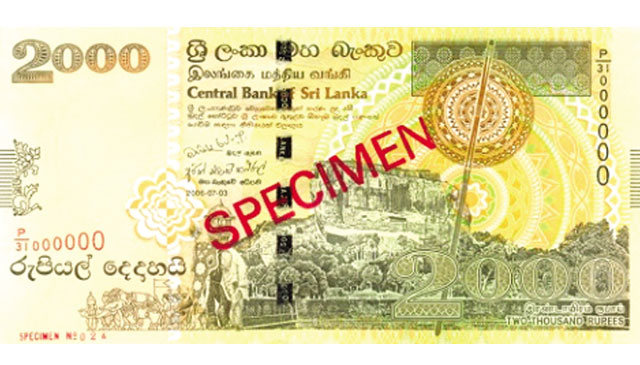
An image of Sigiriya Rock in the centre and a Sesatha on the right.
 Back

A damsel holding a flower (A fresco of Sigiriya).

Know more about in Sri Lanka. Visit Tourist Directory


11th Note Series


Development, Prosperity and Sri Lanka Dancers – 2011


This series consists of following denominations: Rs. 20,50,100,500,1000 and 5000.

Rs. 20 Currency Note


Front

Port of Colombo (a recent and an early view). 
The bird - "Sri Lanka Serendib Scops Owl"; The butterfly - "The Baronet".

Back

"Ves Netuma" dancer (Kandyan dance form) and "Geta bera" drummer. 
Background - "Punkalasa" (pot of plenty) guard stone, " Liya-vela" (single floral design) and map of Sri Lanka.

Rs. 50 Currency Note


Front

New bridge at Manampitiya alongside the old bridge and an ancient 
railway arch bridge in the background. The bird - "Sri Lanka Dull –Blue Flycatcher"; The butterfly - "The Blue Oakleaf".

Back

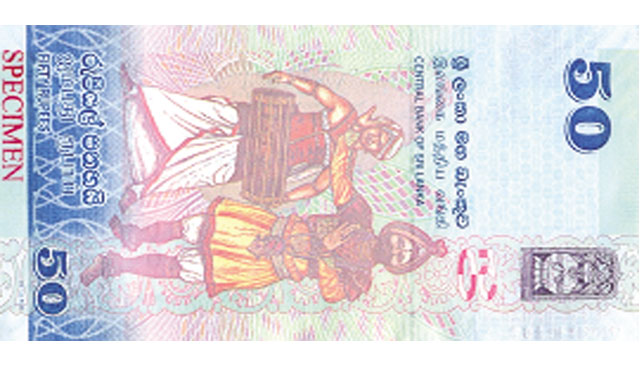
"Vadiga Patuna" dancer (Low Country dance form) and "Yak bera" drummer. 
Background - "Punkalasa" guard stone, "Liya-vela" (single floral design)and map of Sri Lanka.
Rs. 100 Currency Note


Front

 Norochcholai Coal Power Plant Project and Laxapana waterfall in the background. 
The bird - "Sri Lanka Orange Billed Babbler"; 
The butterfly - "The Autumn Leaf".

Back

"Bharatanatyam" dancer (classical South Indian dance form) and "Mridangam " drummer. 
Background - "Naga" guard stone, "Dvithva liya-vela" (double floral design) and map of Sri Lanka.

Rs. 500 Currency Note


Front
.
The World Trade Centre and Bank of Ceylon Headquarters (city of Colombo). An ancient Buddhist temple "Lankatilaka Viharaya" at Kandy in the background. 
The bird - " Sri Lanka Emerald Collared Parakeet (Layard’s Parakeet)"; The butterfly - "The Ceylon Indigo Royal".

Back

"Thelme Netuma" dancer ("Devol Maduwa" ritual - Low Country dance form) and "Yak bera" drummer. Background - "Padmanidhi" guard stone, "Dvithva liya-vela" and map of Sri Lanka.

Rs. 1000 Currency Note


Front

New Ramboda Tunnel and the rock wall/hood at the same location in the background. 
The bird - "Sri Lanka Hanging Parrot"; 
The butterfly -"The White Four Ring".


Back

"Malpadaya Netuma" dancer (Sabaragamuwa dance form) and "Davul bera" drummer. 
Background - Guard stone with guardian deities, "Dvithva liya-vela" and map of Sri Lanka.

Rs. 5000 Currency Note


Front

Weheragala Dam and Canyon Dam in the background. The bird - "Sri Lanka Yellow Eared Bulbul"; The butterfly - "The Lemon Migrant".

Back

"Nagaraksha" and "Guruluraksha" dancers (Low Country mask dance) Background- "Rathnaprasada" guard stone, "Kalpavruksa" (Wishgranting Tree) floral design and map of Sri Lanka.


 See Sri Lankan Coins : Visit Tourist Directory


Sunday, December 20, 2015

Nalanda Gedige - Matale Sri Lanka

Nalanda Gedige  is situated one km to the east of the A9 route 20km north of Aluvihare. It is one of a number of remarkable archaeological sites in Sri Lanka that receive few tourists through no limitations of their own. The reasons for this anomaly are various. Sometimes it has to do with geography and ease of access, although this is not the case with Nalanda. Often, however, it is a case of the beaten tourist track prevailing over good sense. A visit to Nalanda Gedige – gedige is an image house – is strongly recommended, because it exhibits a composite style of architecture unique in Sri Lanka, and an extraordinary fusion of Hinduism and Buddhism. To cap it all, this remarkable shrine occupies an extremely picturesque – if not original – location.

Nalanda Gedige is a curious hybrid of Buddhist and Hindu architecture. Some of the design elements are distinctly Hindu, such as the mandapam or hall of waiting. Yet there is no sign of Hindu gods. There are erotic but eroded Tantric Buddhist carvings, much like the famous ones at Khajuraho in India. The richly decorated façade sections are in the 7th century style which flourished at Madras, South India. However, the southern section has a semi-circular niche containing in high relief a squat figure of Kuvera, the god of wealth, seated on a lotus plinth - an image that is only found in Sri Lanka


Wednesday, August 26, 2015

10 Things to do in Kandy Sri Lanka

1) Visit temple of the Sacred Tooth Relic (Sri Dalada Maligawa)

The most sacred place of Buddhist worship in Sri Lanka and perhaps the world's most sacred Buddhist shrine venerated by millions of the Buddhists all over the world, the Temple of the Sacred Tooth Relic or Sri Dalada Maligawa is a monumental palace built in the heart of the city of Kandy to house the sacred relic of the tooth of Gautama Buddha, brought from Kalinga (Orissa) in India during the reign of Sri Meghavanna (310-28).


2) Visit Kandy National Museum

Lying in between the palatial complex and the Temple of the Sacred Tooth Relic is the Magul Maduwa (audience hall) which is an open-air tall carved wooden pillared pavilion built in 1784 by King Sri Wickrama Rajasinha. The Magul Maduwa which served as an audience hall as well as the place where the Royal Court was convened is a place where a number of historic events took place. It was at the Magul Maduwa that the patriots such as the Madugalle Disava and the Keppettipola Disava who fought against the English for independence were sentenced to death by them. Also it was at this hall that the Kandyan Convention of 1815 was signed between the British and Kandyan Radalas on 5th March 1815 ceding the Kingdom of Kandy- the last kingdom in Sri Lanka - to the British.


3) See Awesome Kandy Lake

The lake surrounded by an ornate wall of 2060 ft in length lies in a parameter of 2.1 miles and the depth of which is about 60 ft. The islet in the centre of the lake was used by the King Sri Wickrama Rajasinha as his private harem and the Royal Bathhouse was used by the king's wives and concubines as a bathhouse.


4) Go to Pothugal Vihara

Pothgul Vihara that has been in existence for about seven decades is a Buddhist temple located in close proximity to the Temple of the Sacred Tooth Relic, perching on the foothills of the famous Udawattekelle Sanctuary, overlooking the breathtaking views of the splendid city of Kandy. The word 'Pothgula' means 'Library' in English. During the British colonial rule, the ancient library known as 'Keerthi Sri Rajasinha Pothgula' located at the Temple of the Sacred Tooth Relic was ruined.

5) Visit Udawattekelle Sanctuary

Located north of the Kandy Lake, 119 hectares in extent, Udawattekelle is a protected forest reserve designated in 1856. The forest reserve which is rich in a variety of plant species and avifauna was declared a sanctuary in 1938. This tall wet evergreen forest is a very popular site especially among local and foreign birders. The lake within the sanctuary attracts many species of birds that feed on fish.

6) Go to British Garrison Cemetery

The cemetery which is managed by the Commonwealth War Graves Commission lies in a serene tranquil location several metres east of the Temple of the Sacred Tooth Relic. Opened in 1822, the British Garrison Cemetery consisting 195 graves is the resting place of British nationals who died while in then colonized Ceylon. The cemetery was closed in 1870s due to lack of space.

7) Shopping at Kandy City Centre Commercial Shopping Complex (KCC)

Located at Dalala Veediya (a street) in the city centre, this is the largest and the most modern shopping complex in the city of Kandy. The shopping complex has been designed with ultra modern features yet preserving the iconic Kandyan architecture. The shopping complex consists of scores of shops including several leading banks, a fully equipped supermarket, a variety of restaurants, an entertainment zone, a well-designed state-of the-art food court and so on.

8) Watch a Cricket match in Asgiriya International Cricket Stadium

Asgiriya stadium, the inception of which dates back to 1910, is Sri Lanka's only stadium owned by a school, Trinity College Kandy. The stadium was built under the pioneering work of Rev Alec Garden Fraser who held the office of the principal of Trinity College for 20 years (1904-1924). In 1981, the stadium was upgraded to an international cricket stadium. Since then a number of international cricket matches have been played, the first being Sri Lanka Vs Australia. Sri Lanka's first Test win at this stadium came in 1998 against Zimbabwe, 15 years after the ground hosted its first Test. The stadium, located in a picturesque setting can be reached within ten minutes from the city centre.

9) Go to Stunning Hantane Mountain Range

Hantane Mountain Range consisting seven peaks the highest being 3800 ft from sea level, lies southwest of the city of Kandy. Popular among mountaineers, Hantane was declared an environmental protection area in 2010 under the National Environment Act. If you are into mountain hiking and visiting Kandy, mist-clad Hantane is ideal for you. Atop the peaks, you can see stunning scenic views of the splendorous hill capital and its suburban areas. Going with an experienced guide is advisable especially during the rainy season.


10) Relax the day at Royal Botanic Gardens- Peradeniya

Lying beside Colombo-Kandy Road six kilometers west of the historic city of Kandy, the Royal Botanic Gardens at Peradeniya occupies a horse-shoe-shaped peninsula and the scenic splendour of the garden has been raised to greater heights by the longest river of Sri Lanka, 'Mahaweli' which flows through its fringes. This is the largest botanic gardens in Sri Lanka, spreading over an area of 147 acres (about 60 hectares) containing about 4,500 plant species.


For more Details Touristdirectory.lk


Tuesday, August 25, 2015

Fishing in Sri Lanka.

Fishing

Fishing as a recreation or sport is quite a popular activity among tourists world over. An island located in the Indian Ocean with an endless coastline and many tanks and rivers, Sri Lanka is a fine destination to do recreational fishing. Many hotels and resorts in the island offer facilities to tourists for recreational fishing. Those who are into fishing could cast their rods or lines with baits in shallow waters or deep sea once they visit this paradise island. You could do fishing in Sri Lanka round the year as the east coast is best from May to September and the west coast from November to April. 


Friday, August 7, 2015

Sri Lanka - The Destination For All

Thank you for choosing Sri Lanka as your dream destination. You are warmly welcome to Sri Lanka – the destination for all – where you could have a wonderful vacation without doubt. The stunning natural beauty of this paradise in the tropics will undoubtedly make you amazed and mesmerized.


Lying off the southern tip of India, the tropical island of Sri Lanka has attracted visitors for centuries with its natural beauty. Sri Lanka was the ideal stopover of ancient seafarers sailing across the Indian Ocean to the Orient. Marco Polo, a great seafarer, who arrived in Sri Lanka in 1265, said "Sri Lanka is the finest island of its size in all the world". Pliny (45 AD), one of the greatest Roman historians wrote: "It had been of long time thought by men in ancient days that Taprobane (Sri Lanka) was a second world".

A glorious history, a rich culture, age-old ruins, the world's most hospitable people, a rich biodiversity, endless tropical beaches, breathtaking coral reefs, verdant valleys of tea plantations, lush virgin rainforests, ranges of mist-clad mountains, splashing waterfalls, oodles of proboscideans in the wild, pods of giants in the blue, priceless gemstones beneath, mouthwatering spicy foods, delicious tropical fruits and what more to call Sri Lanka "A Land Like No Other". Home to eight world heritage sites, Sri Lanka though a small island, has much more to offer. In terms of diversity, Sri Lanka is incomparable and unbeatable. The tropical paradise is blessed with varied landscapes - flat to hilly, climates - hot to mild and cool, cultures - Buddhist to Hindu, fauna - vertebrates to invertebrates, flora - algae to blackwood and so on.

for more info: Touristdirectory.lk


Tuesday, July 28, 2015

Sri Lanka transportation Systems - Things you should know before come to Sri Lanka.


There are many ways to get around Sri Lanka, whether it’s by taxi, plane, rail, bus or car. Sri Lanka has a better transport system operated by public and private sectors and payment method is most often cash.

Sri Lanka has two international airports, 13 domestic airports and about 20 waterdromes (open water aerodrome facilities for seaplanes) across the island. The Bandaranaike International Airport located at Katunayake 32 km north of Colombo is the main international airport of Sri Lanka and the Mattala Rajapaksa International Airport located 264 km southeast of Colombo serves as the second international airport.

Domestic Flights


There are a number of airlines currently operating domestic flights within Sri Lanka offering scheduled flights, scenery flights as well as charter flights. In Sri Lanka are about 13 domestic airports covering the whole island, most of which operate from the Ratmalana airport. A number of seaplanes are also operated from Colombo to many cities across the island.

For more info:  Tourist Directory

Rail


Sri Lanka's rail network is operated by Sri Lanka Railways, linking Colombo with almost all the popular tourist destinations and the other populous cities across the island.

Roads


Sri Lanka has a well-connected national network of roads consisting over 12,000 kms, out of which about 4200 kms of “A” class roads and about 7800 kms of “B” class roads.

Expressways/Highways


Two expressways have newly been constructed in the island; one from Colombo to the Bandaranaike International Airport, another from Colombo to Matara known as Southern Expressway. In addition, an expressway known as Outer Circular Highway that runs 20 km away from the Colombo city centre is being built linking the above two expressways.

Buses


A variety of bus services are readily available in Sri Lanka: normal, intercity, semi-luxury and luxury buses in which you can travel to any part of Sri Lanka.

Luxury Buses


Luxury buses operate from the Central Bus Stand in Colombo to selected destinations such as Galle, Kandy, Badulla, Nuwara Eliya, Jaffna and Trincomalee.

Intercity Buses


Air-conditioned intercity buses travel from one city to another with limited stopovers to make the journey fast and comfortable to the passenger. In these buses only a limited space is available for luggage.

Normal Buses


Hiring Vehicles (Cars/Vans)


Coaches


Three-Wheeler Taxis (Tuk Tuks)


Self-driven Cars


Monday, June 29, 2015

CEYLON CINNAMON (TRUE CINNAMON)


The world renowned Sri Lankan savour
When it comes to spices, cinnamon is without doubt the most spoken among the rest. Cinnamon is obtained from the inner bark of several trees from the genus Cinnamomum, and used in both sweet and savoury foods. “True Cinnamon” alias “Ceylon Cinnamon” is the name used to call the world’ finest cinnamon which is produced nowhere in the world other than in Sri Lanka. In the world are several varieties of cinnamon. Nevertheless, it is True Cinnamon that is world-renowned.  How strong the affinity between cinnamon and Sri Lanka is, is evidenced by its botanical name Cinnamomum  Zeylanicum which is derived from the word Ceylon (Zeylan), former colonial name of Sri Lanka.
Ceylon cinnamon has been very popular all over the world since ancient times. This remote antiquity spice was so highly prized among the olden nations that it was regarded as a gift suitable even for monarchs as well as Gods. Attraction to the True Cinnamon compelled the Portuguese, the Dutch and the British to arrive in to Sri Lanka. History says that the King of the Ceylon who ruled this country in the 6th Century was to supply 250,000 pounds of Cinnamon to Portuguese authorities in return of giving  protection against enemy invasions.
Annual production of cinnamon in the world amounts to 27,500 - 35,000 tons. Sri Lanka is proud to produce 80-90% of the total world supply. Thus, Sri Lanka remains as the main supplier of cinnamon to the entire world.
In Sri Lanka, cinnamon has originated from the Central Hills where several species of cinnamon occur periodically in places such as Kandy, Matale, Haputale and the Sinharaja Forest range. Although Cinnamon cultivation is presently concentrated along the coastal belt stretching from Kalutara to Matara, it has made its way inroads to the inland of Kalutara, Ambalangoda, Matara and Ratnapura.
Production of cinnamon is quite informative. The stems must be processed immediately after harvesting it while the inner bark still remains wet. The cut stems are processed by scraping off the outer bark, then beating the branch evenly with a hammer to loosen the inner bark which is then pried off in long rolls. Then, woody portion is discarded, leaving meter-long Cinnamon strips that are curled into rolls on drying.    
True Cinnamon is a popular spice, once considered more precious than gold because of its delicate fragrance and a sweet pungent taste. Therefore, it is used as a flavoring agent in confectionary, pharmaceutical preparations, chewing gums, toothpaste, cinnamon tea, mouthwashes and mixing with several other Asian curries. Furthermore it is used in the preparation of chocolate in Mexico which is the main importer of True Cinnamon. Additionally, it is also used in the preparation of some kinds of desserts such as apple pie, doughnuts, cinnamon rolls and cinnamon buns as well as spicy candies, hot cocoa and liqueurs.

Research has found amazing benefits of cinnamon which has medicinal value that is making even pharmaceutical companies take notice. Cinnamon has been reported to have remarkable pharmacological effects in the treatment of Type 2 Diabetes Mellitus and Insulin resistance. It has been clinically proven that Cinnamon has ability to boost memory, lower bad Cholesterol and also Cinnamon contains antiseptic properties, help circulation, relieves pain and cold, aids digestion and flu and battles heart disease.


For more info: Touristdirectory.lk